James Webb Telescope Spots Supermassive Black Hole Racing Away from Its Galaxy
By Sarah Published on 10/01/2026 at 09h05 — modified on 09/01/2026 at 09h05 Reading time : 2 minutes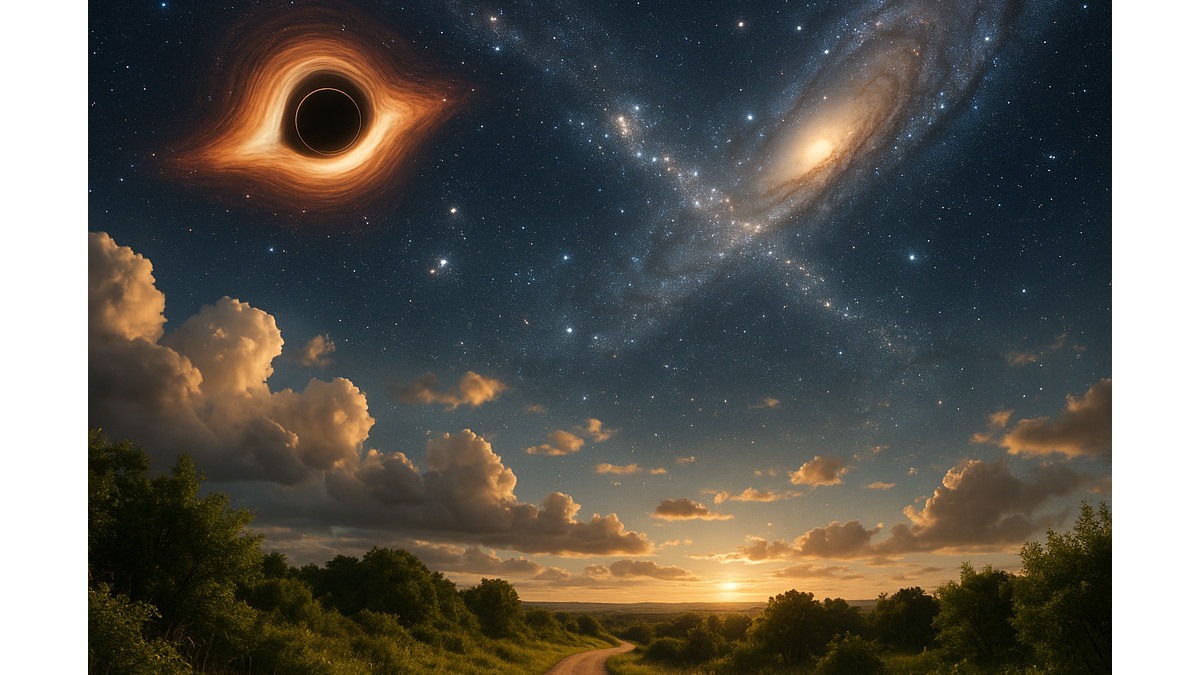 Image credit: AI Generated
The depths of space are often filled with incredible phenomena, but the recent discovery by the James Webb Space Telescope (JWST) truly pushes the boundaries of what scientists thought possible. In a striking display of cosmic power, the JWST has confirmed the presence of a supermassive black hole that appears to be running away from its home galaxy at an astounding speed of 2 million miles per hour. This discovery sheds new light on the complex and dynamic forces shaping the universe.
The Discovery: A Runaway Black Hole
Black holes are notorious for their immense gravitational pull, often anchoring whole galaxies. However, the JWST has revealed a rare situation: a supermassive black hole that is no longer tied to its host galaxy. This black hole is rocketing through space, trailed by a glowing stream of newly formed stars. This dramatic scenario paints a picture of unimaginable energies at work and provides a fresh perspective on galactic evolution.
The Role of the James Webb Space Telescope
Launched to study the deepest mysteries of the cosmos, the JWST is designed with highly advanced infrared imaging capabilities. Peering far beyond what previous telescopes could see, the JWST observed the blazing trail of newborn stars that marks the route of the fleeing black hole. This luminous pathway stretches back toward the black hole's original galaxy, providing direct evidence of its high-velocity journey across deep space.
How Was the Black Hole's Movement Detected?
Unlike typical stationary black holes nestled within galactic centers, this unique object was identified by its movement through intergalactic space. The JWST's detailed images allowed researchers to track the trail, which is marked by regions of active star formation. This sequence is thought to occur as the black hole's immense gravitational influence causes gas to collapse and form new stars as it plows through the cosmos.
Understanding Supermassive Black Holes
Supermassive black holes are found at the heart of most large galaxies, including our own Milky Way. They possess masses millions to billions of times that of the sun. Their gravitational force shapes the structure and fate of galaxies around them. This newfound runaway black hole challenges prior assumptions about their role; rather than being perpetual anchors, some can be violently ejected by powerful cosmic events, such as galaxy mergers or gravitational interactions with other massive objects.
The Bright Trail: Star Formation in Motion
One of the most astonishing features accompanying this runaway black hole is a radiant chain of newborn stars. 🌟 As the black hole escapes its galaxy, it triggers the collapse of gas clouds along its path, igniting bursts of star formation. This process has left a visually striking record—akin to a cosmic breadcrumb trail—linking the black hole to its galactic birthplace. For astronomers, this is not only a rare observation but also an opportunity to study star formation under exotic conditions.
Implications for Galactic Evolution
The ejection of a supermassive black hole from its host galaxy raises intriguing questions about the future of both the black hole and the galaxy it leaves behind. Typically, black holes contribute to regulating star formation and maintaining galactic structure; their absence could have profound effects. Additionally, the star-forming trail offers clues about how such powerful expulsions might spur new generations of stars in regions far from major galaxies.
What Comes Next?
The continuing observations of JWST promise to reveal even more about such rare cosmic events. As technology advances, new discoveries will deepen our understanding of the universe's most extreme phenomena. For now, this event stands as a testament to the dynamic and sometimes unpredictable nature of the cosmos—and the new windows into space that the JWST has opened for human knowledge.
🧠 FAQ - Supermassive Black Holes and Galactic Movement
❓ What did the James Webb Telescope discover about black holes?
The James Webb Space Telescope confirmed the existence of a supermassive black hole escaping its host galaxy at about 2 million mph, leaving behind a trail of newborn stars.
❓ Why is this runaway black hole discovery significant?
It's rare for supermassive black holes to be observed leaving their galaxies. This event provides valuable insights into galaxy evolution and the forces that can eject such massive objects into space.
❓ How does a runaway black hole form a trail of stars?
As the black hole speeds through space, its gravity causes gas clouds in its path to collapse, sparking new star formation and creating a glowing trail back to the parent galaxy.
❓ What role does the JWST play in these discoveries?
The JWST's advanced infrared imaging allows it to detect faint objects and structures in deep space, such as the glowing trail of stars behind a moving black hole, that previous telescopes couldn't observe clearly.
❓ How do supermassive black holes typically affect their galaxies?
Supermassive black holes usually anchor galaxies and regulate star formation through their immense gravitational and energetic influence. Their ejection can impact the host galaxy's development significantly.
❓ Could similar events happen in the Milky Way?
While the phenomena are rare, interactions or mergers with other galaxies could, in principle, result in similar runaway black holes. No such event has been observed in the Milky Way.